

Read this leaflet carefully before you start using this medicine as it contains important information for you.
- Keep this leaflet. You may need to read it again.
- If you have any further questions, talk to your doctor or pharmacist.
- This medicine was prescribed just for you. You shouldn't give it to others. The medicine can be harmful to them even if they have the same signs of disease.
- If you experience any undesirable effects, including possible undesirable effects not indicated in this leaflet, talk to your doctor or pharmacist. See section 4.
What does this leaflet contain:
- What Ottoduo is and what it is used for
- What you need to know before you use Ottoduo
- How to use Ottoduo
- Possible undesirable effects
- How to store Ottoduo
- Contents of the pack and other information
What used for ?
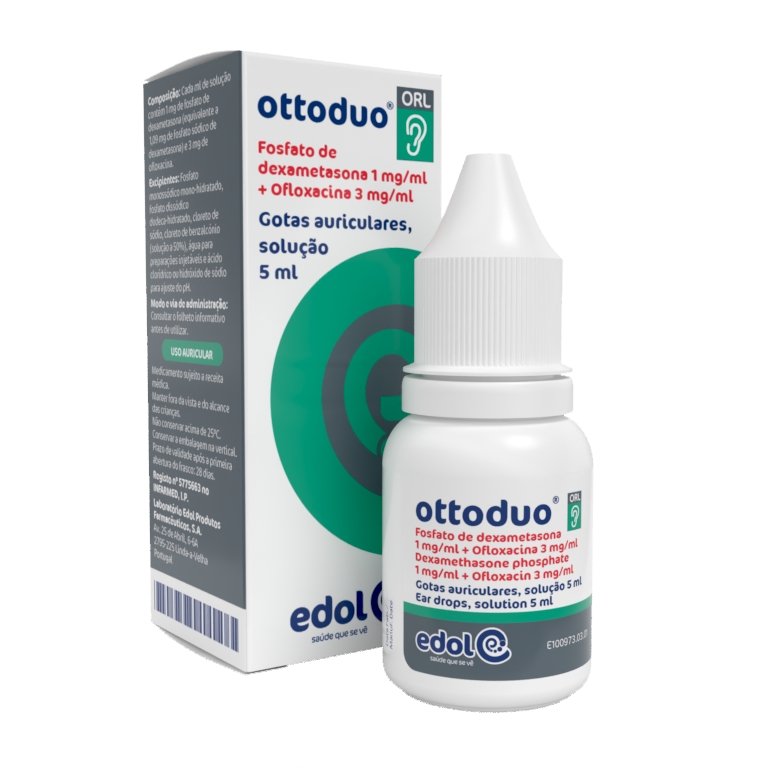
Ottoduo is an association of two active substances, dexamethasone, a corticosteroid, and ofloxacin, an active antibiotic against a wide spectrum of bacteria that can infect the ear.
Ottoduo is indicated for the treatment of the following inflammatory and infectious ear situations, of bacterial origin:
- External otitis in adults and children over 6 months of age,
- Acute otitis media in subjects over 1 year of age with tympanostomy tube.
How to use it ?
Use this medicine exactly as directed by your doctor or pharmacist. Talk to your doctor or pharmacist if you have any questions.
The recommended dose is 3 to 4 drops, instilled in the affected ear, 2 to 3 times a day, for 7 to 10 days.
Use in children
In children, from 6 months to 12 years of age, the usual dosage is 2 drops in the affected ear, 2 times a day, for 7 to 10 days.
Mode of administration
 |
1. Wash your hands with soap and water before administering Ottoduo. |
 |
2. If necessary, carefully clean any dirt or liquid that can be removed from the outside of the ear. Do not insert any object or swabs into the ear canal. |
 |
3. Before administration of Ottoduo, the solution should be heated by placing the bottle between the hands one or two minutes with rotating movements. Applying a cold drop in the ear can cause dizziness to appear. |
 |
4. To proceed to administration tilt the head or preferably lie down to the opposite side of the affected ear. Then apply the number of drops recommended in the affected ear. |
 |
5. The tip of the dropper should not touch the fingers, ear or other surfaces to prevent contamination of the solution. |
 |
6. Make sure you follow the instructions below for your type of ear infection: Otitis media After applying the drops, press the drag (small protrusion to the ear entrance, marked on the figure next carefully 4 times, to facilitate the penetration of the drops into the middle ear (innermost part of the ear). This procedure allows the drops to drain through the ear canal to the middle ear. |
 |
Otitis externa After applying the drops to the ear, pull the lobe of the ear carefully up and down (as pointed out in the figure next to it) to facilitate the passage of the drops through the ear canal. |
 |
7. Keep your head tilted or lie down for 5 minutes after administration of the drug to facilitate the penetration of drops into the ear canal. |
If both ears are infected, repeat the procedures described above in the opposite ear.
If you use more Ottoduo than you should
Cases of overdose with the atrial use of this medicine are not described.
In case of accidental ingestion of the contents of the bottle, you should consult your doctor or pharmacist.
If you forget to use Ottoduo
Do not apply a double dose to make up for a missed dose. Apply the next dose as soon as you remember and then continue as before.
If you stop using Ottoduo
Do not stop using Ottoduo before finishing the duration of treatment imposed by the doctor, even if you already feel better.
If you still have questions about the use of this medicine, talk to your doctor or pharmacist.